The full story
I want to tell you exactly how I found this out.
Not the polished version — the real one. I'm 38 years old, originally from Enugu, though these days I split my time between Lagos and London depending on the season and where my children need me most. I have three children of my own, and for almost two years after my third, I thought something might genuinely be wrong with my body.
I remember the exact moment it started to really bother me. It was my niece's wedding in Lagos — a big Igbo wedding, aso-ebi and all — and I stood in front of the mirror in my hotel room trying on the outfit I'd had tailored months earlier. It didn't sit the way it should. I pinned the wrapper a little tighter, adjusted the blouse, tried three different ways to make it look like it fit. My sister, who had also had three children but "bounced back" within months each time, walked in and said, without any malice at all, "Ah ah, is this not tight for you?" I laughed it off. That night, lying in the hotel room after everyone was asleep, I cried quietly in the bathroom, and I didn't fully understand why.
That was the beginning of nearly two years of trying everything.
I wore it almost four months, sometimes eight hours a day, convinced discipline alone would "train" my body back. I sweated through blouses, got heat rashes along my ribs — and when I stopped wearing it, my stomach looked exactly the same.
Crunches, planks, the abdominal circuit that "worked" years earlier. This time, nothing changed — some days I felt more discomfort in my lower back than any visible difference at all.
A woman in my church WhatsApp group swore by it. Three weeks in, it gave me stomach upset most mornings and made me irritable with my children by mid-afternoon. My stomach did not change at all.
I became weak, short-tempered, a worse version of myself around my own children — snapping over small things because I was hungry and exhausted. Still, nothing changed underneath.
She finally said, "Honestly, Grace, I think it's just genetics." I put the phone down feeling worse than before I asked — like there was simply nothing I could do.
By this point I had spent money I don't like to admit — and something harder to get back: almost two years of feeling like a stranger in my own body. I stopped going to certain events. I declined invitations where I knew photos would be taken. My husband never said one unkind word through any of it — not once — but I still found myself pulling away some nights, not because of anything he did, but because of how I felt about myself.
The turning point came from somewhere completely unexpected. My friend Adaeze, who trained as a physiotherapist in London, asked me something no one had ever asked before: "Have you checked for separation?" She explained that many women develop a separation in the abdominal muscles after multiple pregnancies — and that the very exercises I thought were "core work" can actually make it worse. She showed me, over a video call, a simple hands-on self-check I could do lying down, using just my fingers. It took less than two minutes.
I did it that same night. And I felt it — a gap, clear as anything, right along the middle of my stomach.
I sat on my bathroom floor afterward and felt something I hadn't felt in almost two years: relief. Not because the problem was solved — because for the first time, it had a name. It wasn't "genetics." It wasn't me "not trying hard enough." It was something specific, something I could actually work with instead of quietly blaming myself for.
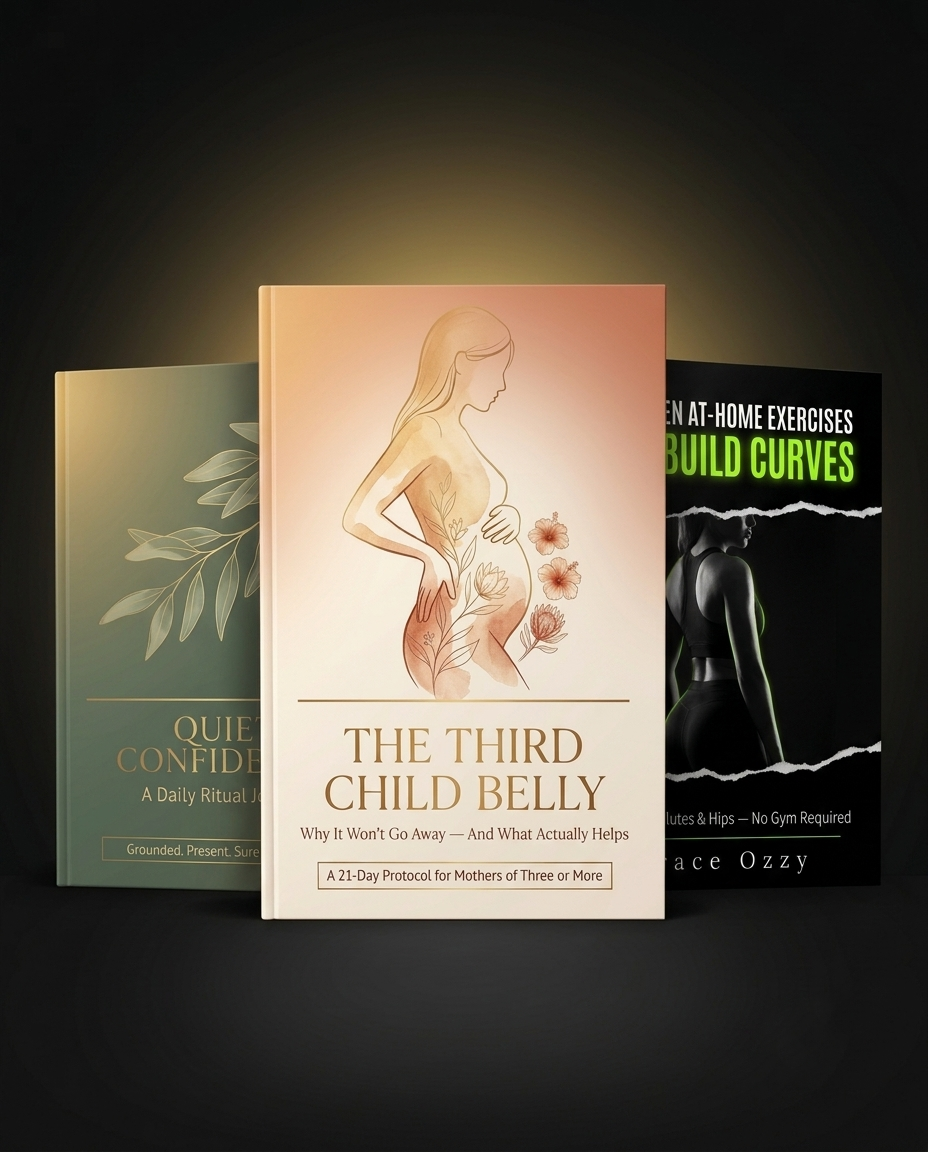
I didn't build this because I became an expert overnight. I built it because I wish, more than almost anything, someone had handed this to me two years earlier — before the wedding, before the waist trainer, before the tea that upset my stomach for nothing. I built it for the version of me standing in that hotel bathroom, and for every woman standing in her own version of that same room right now.